

AI Rankings for Commercial Prompts: Where Brand Consideration Really Happens

AI search has changed how people find answers and where buying decisions happen.
The traditional search model puts the work on the user. You Googled. You opened tabs. You compared vendors. You evaluated options yourself.
In an AI-first world, you open ChatGPT and ask for the best option. The system does the comparing for you.
That shift compresses the buyer’s journey and concentrates commercial value in one place: the consideration phase. When AI pre-filters options, brands lose visibility before the sales conversation even begins, often without realizing it until they check their AI readiness score.
The AI marketing funnel explained
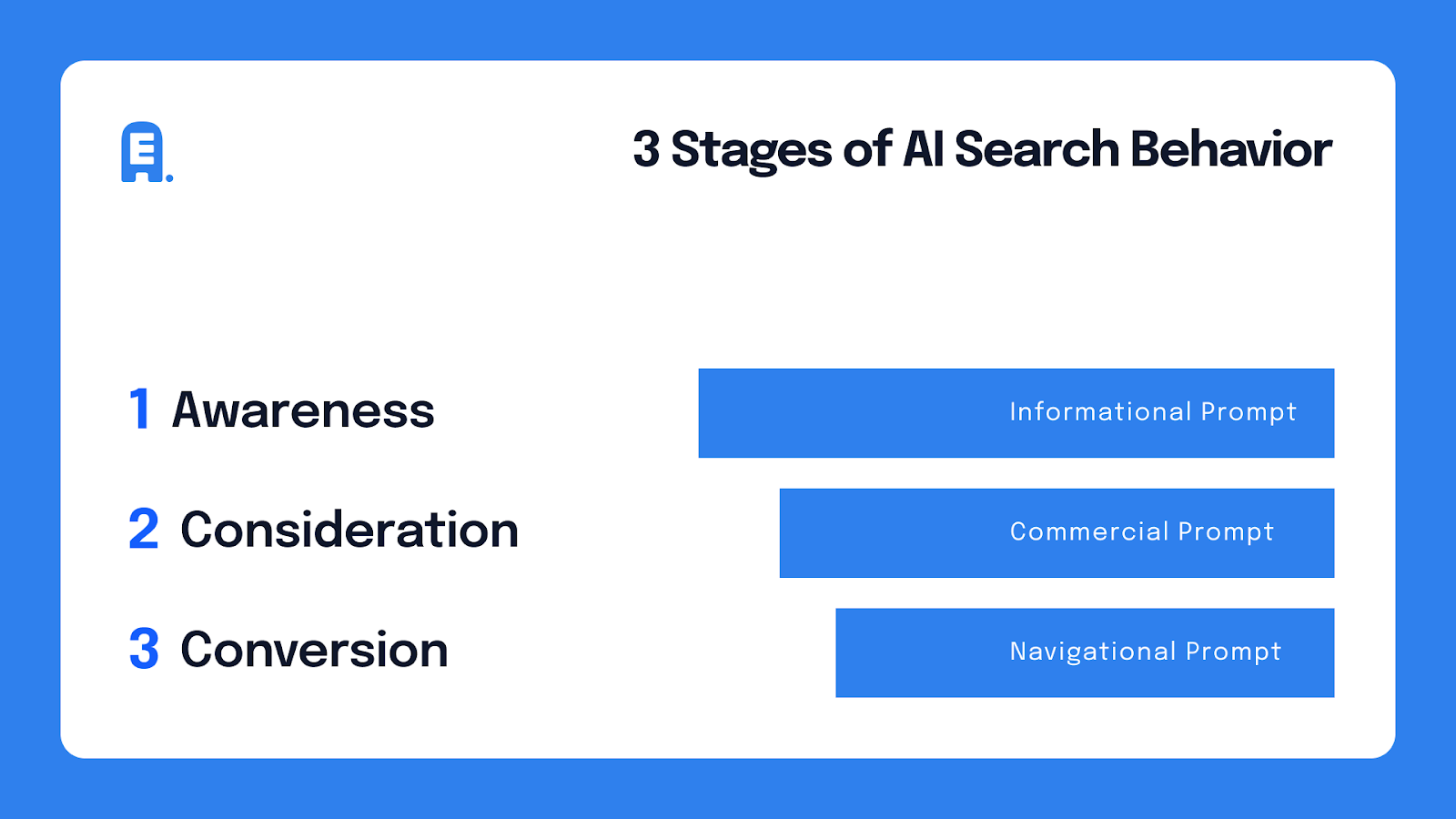
Traditional marketing breaks the buyer’s journey into three stages:
- Top of the funnel: Awareness
- Middle of the funnel: Consideration
- Bottom of the funnel: Conversion
But when those stages are mapped to AI search behavior, they look a little different.
AI Awareness Phase
At the awareness stage of the AI marketing funnel, users ask informational questions, like “how does AEO work?” and “What is venture capital?” And then they get answers directly within AI tools. That means no click, no brand visit, and no visible shortlist.
In many cases, any direct brand visibility disappears here. AI summarizes the topic and moves on.
AI Consideration Phase
The consideration phase also behaves differently. Here, users will ask their AI companion of choice:
- “Who are the best options?”
- “Which firms specialize in X niche?”
- “How does Brand X compare to Brand Y?”
This is where commercial intent lives now, and it’s where shortlists are formed.
AI Bottom of the Funnel
The bottom of the funnel still exists, but much of the filtering now happens before a sales conversation begins.
And that’s why commercial prompts matter more than ever.
From keywords to intent clusters
Where search optimization used to revolve around keywords, AI optimization revolves around intent clusters.
The difference is structural. Keywords helped pages rank. Intent clusters determine how AI systems group, compare, and prioritize brands within a category.
Topical authority still matters. But now it has to connect to how buyers actually make decisions, not just how search engines crawl pages.
And once AI starts ranking, perception forms quickly. Positioning inside the response shapes credibility long before a user decides to click to your site. And it’s all based on the signals AI systems are trained to prioritize.
What’s a commercial prompt?
Commercial prompts are high-intent queries that are used during evaluation, and they typically fall into two categories:
- Best-in-class prompts
- Comparison prompts
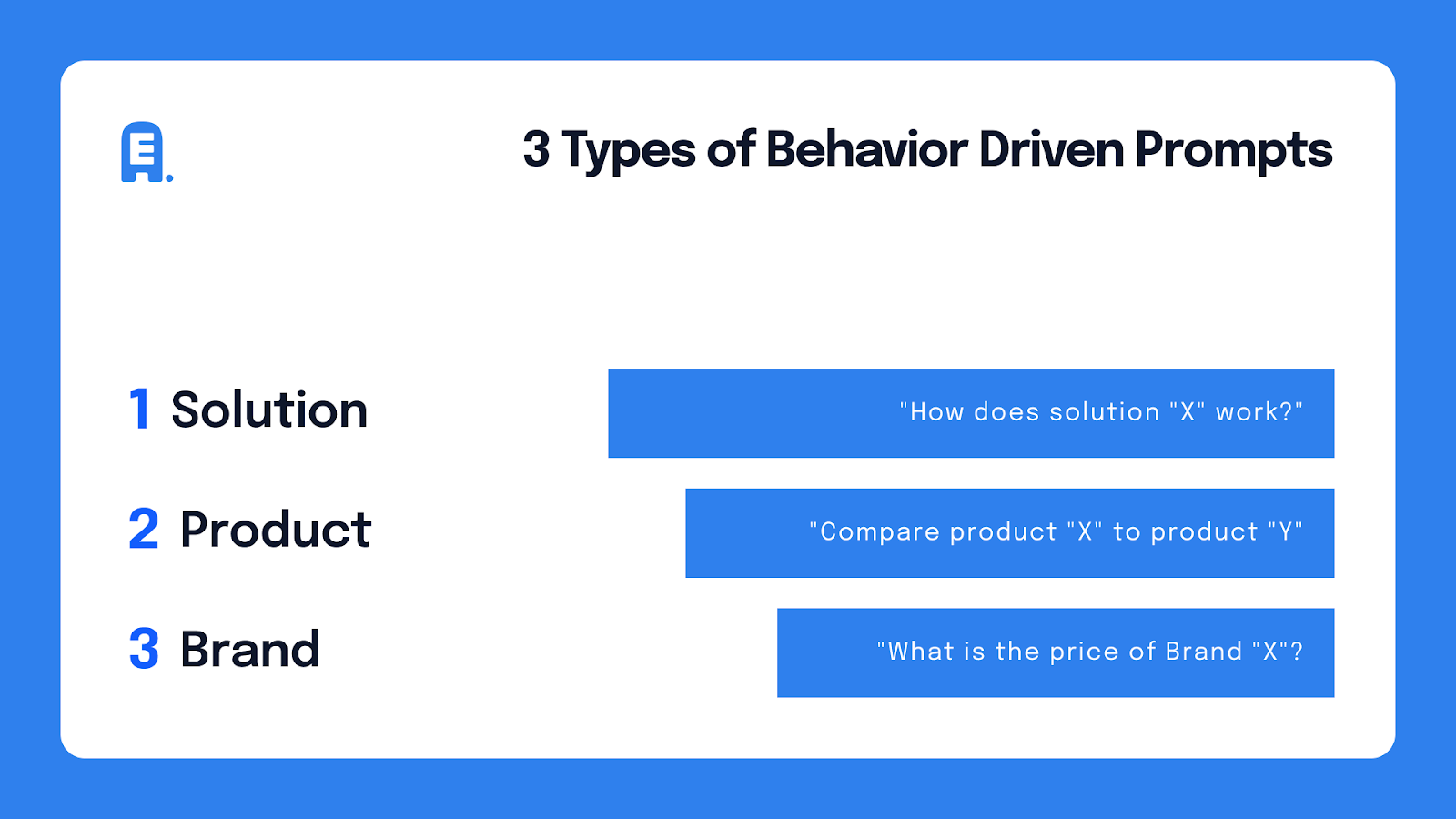
Behavior with commercial intent often looks like:
- “Best venture capital firms for early-stage SaaS startups.”
- “Top-rated enterprise software investors in 2026.”
- “Compare Brand X vs Sequoia Capital for AI funding.”
What these prompts indicate is the intent to choose, and they indicate the user’s intent to evaluate brands, rather than explore options.
And that distinction matters.
An example of commercial prompts for a VC brand
Imagine a VC firm focused on Tech and SaaS startups.
Their “best-in-class” prompts might include:
- “Top venture capital firms in the USA for early-stage startups.”
- “Leading B2B SaaS investors in the United States in 2026.”
- “Best venture capital funds for enterprise software and AI companies.”
- “Highly reviewed active early-stage VC firms in the USA.”
- “Top-rated venture capital firms investing in deep tech.”
“Comparison” prompts in this vein might include:
- “Who are the competitors of Brand X investing in SaaS and Tech?”
- “Compare Brand X against Brand Y for AI startup funding.”
- “Brand X vs Brand Y for SaaS company funding.”
These prompts signal selection intent, meaning they occur much later in the funnel.
And if your brand doesn’t appear here, it’s absent from the shortlist.
How Edgar Allan measures commercial intent in AI tools
Once the commercial prompts are defined, the next question is about measurement.
We evaluate AI commercial rankings using three core metrics.
- Frequency
How many times does the brand appear within a single AI-generated response?
AI systems return and repeat the brands that best fit the question. More mentions mean the system sees you as a real answer, not as a footnote. The great thing is that recognition sticks with the reader, too.
More mentions increase salience. They also increase the likelihood that the brand becomes cognitively linked to the solution set in the user’s mind.
- Average position
Where does the brand appear in the ranked output?
AI responses often present ranked or semi-ranked lists, even if they do not explicitly number them. The order still implies hierarchy.
Being first in a “Top 10” list shapes perception differently than appearing 10th. Early placement implies category leadership. And lower placement suggests secondary relevance.
Position influences consideration probability because AI tools frame the list before the user evaluates individual brands. When a brand consistently appears near the top, it benefits from implied endorsement within the context of the response.
- Weighted score
A composite score from zero to one that combines frequency and average position.
This metric balances how often a brand appears with how prominently it is positioned. High frequency with low placement does not signal dominance. High placement with minimal repetition does not signal authority. The weighted score accounts for both.
The result is one clear number that tells you whether you're actually winning in AI search, or just showing up.
Together, these metrics reveal two important aspects of AI visibility:
- How often the brand is mentioned.
- How favorably it’s positioned relative to competitors.
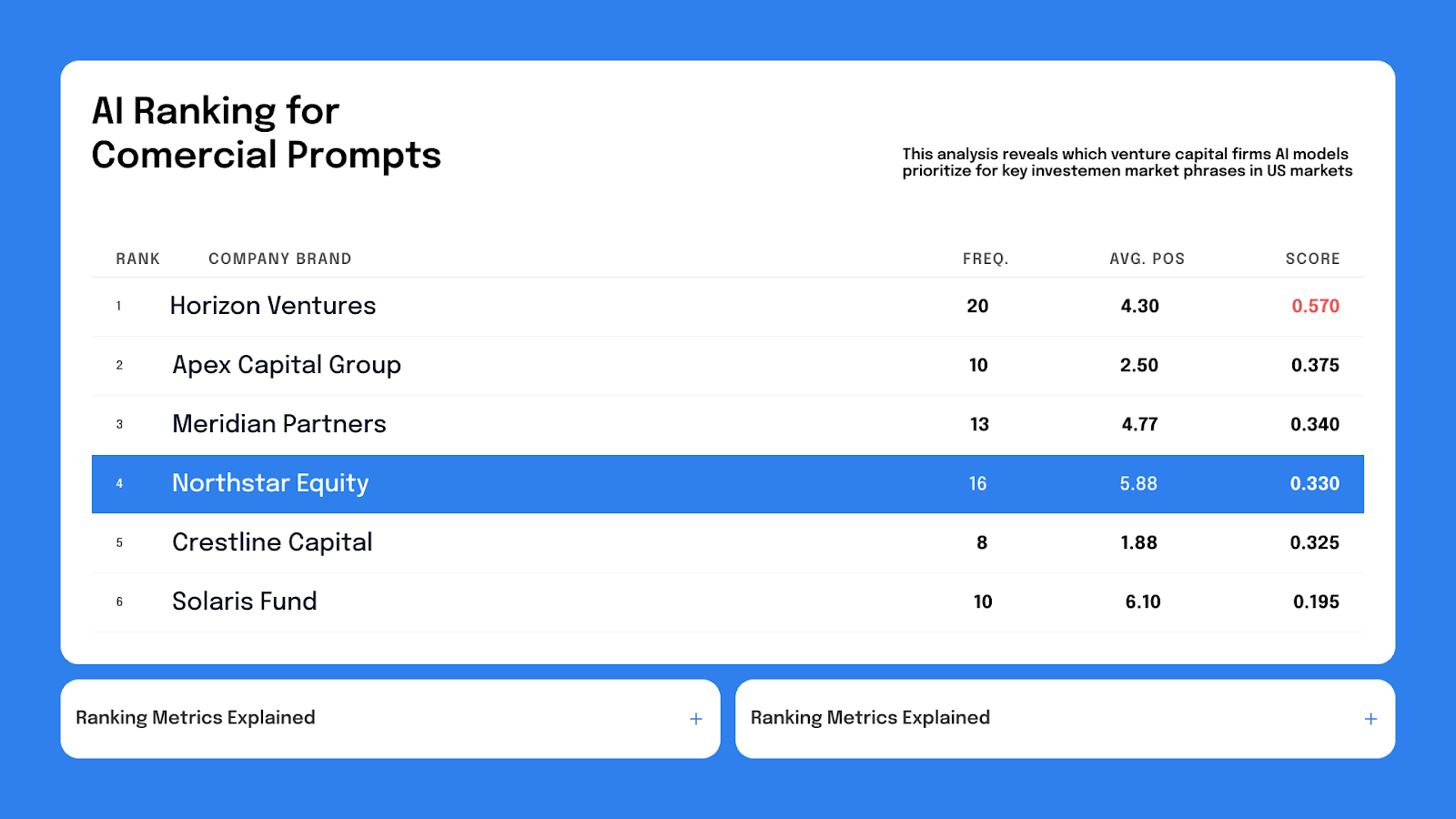
Not all mentions carry equal influence. Higher placement creates a stronger association and a higher consideration probability. Consistently low positioning signals weak authority within commercial clusters.
Why this changes AEO strategy
In traditional SEO, ranking position influenced click-through rate, and in AI search, ranking position influences interpretation.
Being listed first shapes how a brand is framed in relation to others. Being listed tenth can diminish perceived relevance.
And that makes commercial prompt tracking essential.
Tools like Profound send commercial prompts daily across multiple AI engines and crawl outputs to track ranking behavior and volatility over time. This allows us to:
- Map ranking behavior.
- Measure movement over time.
- Compare competitors objectively.
- Plot AI visibility alongside SEO and other brand metrics.
The result is measurable commercial positioning, not anecdotal visibility.
What to do with this insight
If most awareness questions are answered inside AI tools, and most commercial intent now surfaces in consideration prompts, your strategy must shift.
Start by identifying the commercial prompts that define your category and track:
- Frequency
- Position
- Weighted visibility score
Then align content and authority-building efforts around the prompts that influence shortlist formation.
AI search compresses the funnel and concentrates influence where ranking matters most.
Want to see how your brand ranks across high-intent AI prompts and how that compares to your competitors? Contact us, and we’ll show you.
Read more from the Edgar Allan Blog.
- What AI Search Actually Rewards: Expertise, POV, and Saying Something Real
- Machines Are Reading Your Website (And They’re Probably Getting Your Brand All Wrong)
- Machines Are Reading Your Website (And They’re Probably Getting Your Brand All Wrong) Part 2
- From Discovery to Decision: How AEO Changed the CRO Playbook
- When Discovery Disappears: What Happens to Websites in an AI-First Internet
The AI marketing funnel explained
Traditional marketing breaks the buyer’s journey into three stages:
- Top of the funnel: Awareness
- Middle of the funnel: Consideration
- Bottom of the funnel: Conversion
But when those stages are mapped to AI search behavior, they look a little different.
AI Awareness Phase
At the awareness stage of the AI marketing funnel, users ask informational questions, like “how does AEO work?” and “What is venture capital?” And then they get answers directly within AI tools. That means no click, no brand visit, and no visible shortlist.
In many cases, any direct brand visibility disappears here. AI summarizes the topic and moves on.
AI Consideration Phase
The consideration phase also behaves differently. Here, users will ask their AI companion of choice:
- “Who are the best options?”
- “Which firms specialize in X niche?”
- “How does Brand X compare to Brand Y?”
This is where commercial intent lives now, and it’s where shortlists are formed.
AI Bottom of the Funnel
The bottom of the funnel still exists, but much of the filtering now happens before a sales conversation begins.
And that’s why commercial prompts matter more than ever.
From keywords to intent clusters
Where search optimization used to revolve around keywords, AI optimization revolves around intent clusters.
The difference is structural. Keywords helped pages rank. Intent clusters determine how AI systems group, compare, and prioritize brands within a category.
Topical authority still matters. But now it has to connect to how buyers actually make decisions, not just how search engines crawl pages.
And once AI starts ranking, perception forms quickly. Positioning inside the response shapes credibility long before a user decides to click to your site. And it’s all based on the signals AI systems are trained to prioritize.
What’s a commercial prompt?
Commercial prompts are high-intent queries that are used during evaluation, and they typically fall into two categories:
- Best-in-class prompts
- Comparison prompts
Behavior with commercial intent often looks like:
- “Best venture capital firms for early-stage SaaS startups.”
- “Top-rated enterprise software investors in 2026.”
- “Compare Brand X vs Sequoia Capital for AI funding.”
What these prompts indicate is the intent to choose, and they indicate the user’s intent to evaluate brands, rather than explore options.
And that distinction matters.
An example of commercial prompts for a VC brand
Imagine a VC firm focused on Tech and SaaS startups.
Their “best-in-class” prompts might include:
- “Top venture capital firms in the USA for early-stage startups.”
- “Leading B2B SaaS investors in the United States in 2026.”
- “Best venture capital funds for enterprise software and AI companies.”
- “Highly reviewed active early-stage VC firms in the USA.”
- “Top-rated venture capital firms investing in deep tech.”
“Comparison” prompts in this vein might include:
- “Who are the competitors of Brand X investing in SaaS and Tech?”
- “Compare Brand X against Brand Y for AI startup funding.”
- “Brand X vs Brand Y for SaaS company funding.”
These prompts signal selection intent, meaning they occur much later in the funnel.
And if your brand doesn’t appear here, it’s absent from the shortlist.
How Edgar Allan measures commercial intent in AI tools
Once the commercial prompts are defined, the next question is about measurement.
We evaluate AI commercial rankings using three core metrics.
- Frequency
How many times does the brand appear within a single AI-generated response?
AI systems return and repeat the brands that best fit the question. More mentions mean the system sees you as a real answer, not as a footnote. The great thing is that recognition sticks with the reader, too.
More mentions increase salience. They also increase the likelihood that the brand becomes cognitively linked to the solution set in the user’s mind.
- Average position
Where does the brand appear in the ranked output?
AI responses often present ranked or semi-ranked lists, even if they do not explicitly number them. The order still implies hierarchy.
Being first in a “Top 10” list shapes perception differently than appearing 10th. Early placement implies category leadership. And lower placement suggests secondary relevance.
Position influences consideration probability because AI tools frame the list before the user evaluates individual brands. When a brand consistently appears near the top, it benefits from implied endorsement within the context of the response.
- Weighted score
A composite score from zero to one that combines frequency and average position.
This metric balances how often a brand appears with how prominently it is positioned. High frequency with low placement does not signal dominance. High placement with minimal repetition does not signal authority. The weighted score accounts for both.
The result is one clear number that tells you whether you're actually winning in AI search, or just showing up.
Together, these metrics reveal two important aspects of AI visibility:
- How often the brand is mentioned.
- How favorably it’s positioned relative to competitors.
Not all mentions carry equal influence. Higher placement creates a stronger association and a higher consideration probability. Consistently low positioning signals weak authority within commercial clusters.
Why this changes AEO strategy
In traditional SEO, ranking position influenced click-through rate, and in AI search, ranking position influences interpretation.
Being listed first shapes how a brand is framed in relation to others. Being listed tenth can diminish perceived relevance.
And that makes commercial prompt tracking essential.
Tools like Profound send commercial prompts daily across multiple AI engines and crawl outputs to track ranking behavior and volatility over time. This allows us to:
- Map ranking behavior.
- Measure movement over time.
- Compare competitors objectively.
- Plot AI visibility alongside SEO and other brand metrics.
The result is measurable commercial positioning, not anecdotal visibility.
What to do with this insight
If most awareness questions are answered inside AI tools, and most commercial intent now surfaces in consideration prompts, your strategy must shift.
Start by identifying the commercial prompts that define your category and track:
- Frequency
- Position
- Weighted visibility score
Then align content and authority-building efforts around the prompts that influence shortlist formation.
AI search compresses the funnel and concentrates influence where ranking matters most.
Want to see how your brand ranks across high-intent AI prompts and how that compares to your competitors? Contact us, and we’ll show you.
Read more from the Edgar Allan Blog.
- What AI Search Actually Rewards: Expertise, POV, and Saying Something Real
- Machines Are Reading Your Website (And They’re Probably Getting Your Brand All Wrong)
- Machines Are Reading Your Website (And They’re Probably Getting Your Brand All Wrong) Part 2
- From Discovery to Decision: How AEO Changed the CRO Playbook
- When Discovery Disappears: What Happens to Websites in an AI-First Internet