
.png)
Content Strategy for AEO: Why Prompt Visibility Comes First

When it comes to AEO strategy, a lot of brands default to what’s familiar and start the process with keyword research and content. After all, that’s how the web’s worked for so long. You mapped search volume, ranked difficulty, and built pages around the phrases people were typing into Google.
But that model doesn’t match how decisions are made anymore. If you are concerned that answer engines are misreading your brand, explore our practical implementation roadmap. (P.S. Our AI Readiness Score assessment can also help you gauge where you brand stands on the AEO spectrum.)
In AI search, users don’t type fragments; they ask full questions. They compare vendors, pressure-test trade-offs, ask who is the best, who is expensive, who is credible, and who works well in a specific region or use case.
And that shift fundamentally changes how content strategy works, because AEO doesn’t start with content. It starts with prompt research.
From keyword research to prompt research
The biggest difference between SEO and AEO is methodological.
When SEO was the only option, keyword research told you what people searched for; now, prompt research tells you how people evaluate.
At Edgar Allan, we built our AEO content strategy around key topic visibility rather than keywords. starting with prompt research.The challenge, as we’ve learned, is not just identifying prompt themes. It’s understanding:
- What topic clusters exist within AI tools like ChatGPT, Gemini, and Perplexity.
- How often those prompts are queried by users.
- Where your brand already appears.
- Where competitors dominate.
- What the potential audience size actually is.
That final piece matters most because prompt volume reveals potential and sets realistic expectations for what AEO can actually deliver.
Without that context, content strategy becomes guesswork.
Why key topic volume matters
By now, most brands know they need to invest in AEO, but fewer know what that investment really requires.
How much content needs to be created?
Which regions require focus?
How competitive are the target topics?
What internal strain will doing any of this create?
Key topic visibility research answers those questions. By analyzing topic clusters, competition levels, regional differences, and AI volume, we can define:
- The scale of content required.
- The likely difficulty of re-ranking for commercial terms.
- The timeline for meaningful impact.
- The internal and external resource load.
A highly competitive commercial topic cluster with high prompt volume may require foundational authority-building before ranking becomes realistic. For example, brands targeting broad, high-intent prompts often need to establish credibility across supporting topics before AI systems surface them as a top option. That clarity allows leadership teams to allocate budget with intent instead of optimism.
What we measure in key topic visibility analysis
- Topic-Level Visibility Index
We look at the prompt topics a brand already appears for and measure visibility per topic. A prompt topic might be something like “best Webflow agency for B2B SaaS,” “top early-stage fintech investors,” or “enterprise endpoint security platforms.” Each topic receives a visibility index based primarily on how frequently the brand is mentioned within AI-generated answers tied to that theme.
This tells us where the brand is strongest and where it’s effectively invisible.
- Entity Associations
AI tools connect brands to certain, relevant entities. Think CEOs, founders, industry figures, adjacent companies, trusted directories, etc.
We analyze those connections to determine how generative AI models associate a brand with those entities by crawling online sources and structured directories. This helps explain why certain topics show up consistently and others don't, and it reveals the credibility signals most brands aren't actively managing.
- Regional Topic Performance
A brand may appear strongly in one region and barely register in another.
We analyze prompt visibility by region across AI tools like ChatGPT, Gemini, and Perplexity to understand where geographic performance diverges. This includes identifying region-specific prompt clusters, local competitive dynamics, and variations in AI citation behavior.
Regional differences often reveal misalignment between go-to-market focus and actual AI visibility. A brand expanding into EMEA may find it is visible in North America but absent in region-specific commercial prompts abroad. Or a company with strong global authority may see localized competitors dominate in certain markets.
This analysis informs us which markets require foundational content development, where incremental investment will produce meaningful lift, and whether regional AEO campaigns are necessary.
Regional visibility is rarely accidental. It reflects content depth, authority signals, and market focus.
- AI Volume
AI volume estimates the monthly prompt frequency for topics your brand already appears for and topics you want to rank for.
This is where expectations become grounded.
Some commercial terms carry significant prompt volume but are highly competitive. Others have lower volume but higher conversion intent.
Understanding both allows us to:
- Set realistic growth targets.
- Identify achievable wins.
- Anticipate re-ranking challenges.
- Prioritize content investment.
Volume alone does not create opportunity. Opportunity emerges when volume is understood alongside visibility and competition.
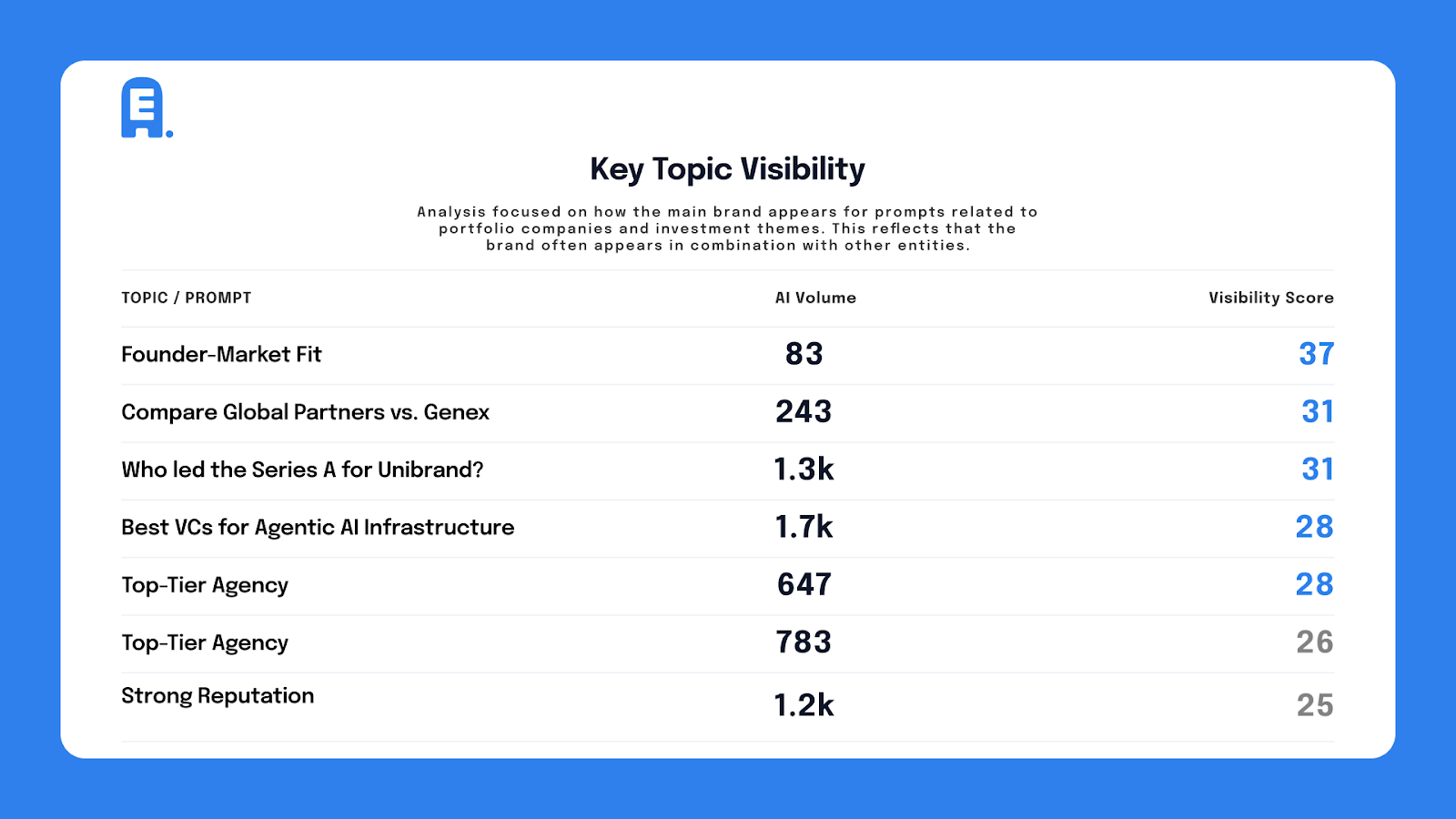
What the key topic visibility report reveals
In most cases, a brand’s strongest topic cluster is not aligned with its go-to-market priorities.
That one surprises just about every leadership team.
More often than not, visibility is concentrated around:
- Founder narratives
- Industry commentary
- Awards and recognition
- Peripheral associations or adjacent tools
These topics build awareness and create relevance. But they rarely drive commercial intent.
Meanwhile, visibility for core service or market terms tends to be thin. A cybersecurity company might appear in prompts about its CEO or funding round, but not in prompts about enterprise endpoint protection. A Webflow agency may surface in design community discussions, but not in prompts asking for “best Webflow partner for B2B SaaS.”
Once you know this, the gap becomes clear: the brand is visible, but not where buying decisions are made.
And that disconnect shapes content strategy.
Turning visibility insights into AEO strategy
Once we understand topic visibility, we develop a strategy with three priorities.
- Move toward high-intent, non-branded topics
Commercial value lives in market and service terms, and high-intent prompts usually contain evaluation language:
- Best
- Top
- Compare
- Alternative
- Pricing
- Enterprise
- For [industry]
These are the queries that shape vendor shortlists. If a brand is absent from them, awareness does not convert into pipeline. We build topical authority around non-branded prompt clusters that reflect buying intent. That requires structured expansion across:
- Core service pages
- Comparative positioning
- Use-case depth
- Industry-specific applications
- Objection-handling content
More than creating content for the sake of it, this approach requires creating complete topical coverage so AI systems associate a brand with commercial categories, and not just a high volume of content.
- Strengthen the weak but promising clusters
Some topics show partial visibility.
The brand appears within a cluster, but only across limited subtopics. For example, it may surface for “Series A investors” but not “early-stage fintech investors.” Or it may rank for “Webflow development” but not “Webflow enterprise migration.”
These are great opportunities.
Here, the authority foundation exists, and AI systems already recognize the brands within that thematic space. What’s missing is depth.
In these cases, we expand systematically across subtopics within the same commercial theme. This often produces faster gains than attacking entirely new categories where the brand has no visibility history.
Strategically, this is where resource allocation becomes disciplined rather than reactive.
- Align with go-to-market priorities
AEO strategy cannot exist in isolation, and content priorities must align with:
- Market expansion plans
- Campaign focus areas
- Sales motion
- Regional investment
If a company is expanding into healthcare, its prompt visibility within healthcare-specific clusters becomes a strategic priority. If a campaign is centered on enterprise pricing, visibility around enterprise evaluation prompts must support it.
We develop an AEO content strategy only after aligning key topic visibility insights with broader go-to-market direction.
When that alignment is clear, visibility growth supports revenue growth. The work compounds instead of competing with other initiatives.
AEO is as strategic as SEO has ever been
Visibility now depends on how AI interprets topic authority across prompt clusters, not just where a page ranks.
When brands skip the research and strategic phases, they default to content production without direction. That creates activity, not advantage.
When brands start with key topic visibility analysis, they understand:
- Where they stand.
- What opportunity exists.
- What competition looks like.
- What scale of effort is required.
From there, content strategy becomes structured, measurable, and aligned with commercial goals.
What to do next
If you’re investing in AEO, begin with prompt research, not production, and understand:
- Which topic clusters define your category.
- Where your brand already appears.
- Where commercial intent lives.
- What regional differences exist.
- How much AI volume supports each opportunity.
Know exactly where you stand, then build content deliberately.
AEO rewards clarity, consistency, and topical depth. The brands that win in AEO treat prompt visibility as infrastructure, not an experiment. And that starts with knowing where you actually stand before you write a single word.
Want to see how your brand performs across key prompt clusters and where commercial visibility gaps exist? Contact us, and we’ll show you.
Read more from the Edgar Allan Blog.
From keyword research to prompt research
The biggest difference between SEO and AEO is methodological.
When SEO was the only option, keyword research told you what people searched for; now, prompt research tells you how people evaluate.
At Edgar Allan, we built our AEO content strategy around key topic visibility rather than keywords. starting with prompt research.The challenge, as we’ve learned, is not just identifying prompt themes. It’s understanding:
- What topic clusters exist within AI tools like ChatGPT, Gemini, and Perplexity.
- How often those prompts are queried by users.
- Where your brand already appears.
- Where competitors dominate.
- What the potential audience size actually is.
That final piece matters most because prompt volume reveals potential and sets realistic expectations for what AEO can actually deliver.
Without that context, content strategy becomes guesswork.
Why key topic volume matters
By now, most brands know they need to invest in AEO, but fewer know what that investment really requires.
How much content needs to be created?
Which regions require focus?
How competitive are the target topics?
What internal strain will doing any of this create?
Key topic visibility research answers those questions. By analyzing topic clusters, competition levels, regional differences, and AI volume, we can define:
- The scale of content required.
- The likely difficulty of re-ranking for commercial terms.
- The timeline for meaningful impact.
- The internal and external resource load.
A highly competitive commercial topic cluster with high prompt volume may require foundational authority-building before ranking becomes realistic. For example, brands targeting broad, high-intent prompts often need to establish credibility across supporting topics before AI systems surface them as a top option. That clarity allows leadership teams to allocate budget with intent instead of optimism.
What we measure in key topic visibility analysis
- Topic-Level Visibility Index
We look at the prompt topics a brand already appears for and measure visibility per topic. A prompt topic might be something like “best Webflow agency for B2B SaaS,” “top early-stage fintech investors,” or “enterprise endpoint security platforms.” Each topic receives a visibility index based primarily on how frequently the brand is mentioned within AI-generated answers tied to that theme.
This tells us where the brand is strongest and where it’s effectively invisible.
- Entity Associations
AI tools connect brands to certain, relevant entities. Think CEOs, founders, industry figures, adjacent companies, trusted directories, etc.
We analyze those connections to determine how generative AI models associate a brand with those entities by crawling online sources and structured directories. This helps explain why certain topics show up consistently and others don't, and it reveals the credibility signals most brands aren't actively managing.
- Regional Topic Performance
A brand may appear strongly in one region and barely register in another.
We analyze prompt visibility by region across AI tools like ChatGPT, Gemini, and Perplexity to understand where geographic performance diverges. This includes identifying region-specific prompt clusters, local competitive dynamics, and variations in AI citation behavior.
Regional differences often reveal misalignment between go-to-market focus and actual AI visibility. A brand expanding into EMEA may find it is visible in North America but absent in region-specific commercial prompts abroad. Or a company with strong global authority may see localized competitors dominate in certain markets.
This analysis informs us which markets require foundational content development, where incremental investment will produce meaningful lift, and whether regional AEO campaigns are necessary.
Regional visibility is rarely accidental. It reflects content depth, authority signals, and market focus.
- AI Volume
AI volume estimates the monthly prompt frequency for topics your brand already appears for and topics you want to rank for.
This is where expectations become grounded.
Some commercial terms carry significant prompt volume but are highly competitive. Others have lower volume but higher conversion intent.
Understanding both allows us to:
- Set realistic growth targets.
- Identify achievable wins.
- Anticipate re-ranking challenges.
- Prioritize content investment.
Volume alone does not create opportunity. Opportunity emerges when volume is understood alongside visibility and competition.
What the key topic visibility report reveals
In most cases, a brand’s strongest topic cluster is not aligned with its go-to-market priorities.
That one surprises just about every leadership team.
More often than not, visibility is concentrated around:
- Founder narratives
- Industry commentary
- Awards and recognition
- Peripheral associations or adjacent tools
These topics build awareness and create relevance. But they rarely drive commercial intent.
Meanwhile, visibility for core service or market terms tends to be thin. A cybersecurity company might appear in prompts about its CEO or funding round, but not in prompts about enterprise endpoint protection. A Webflow agency may surface in design community discussions, but not in prompts asking for “best Webflow partner for B2B SaaS.”
Once you know this, the gap becomes clear: the brand is visible, but not where buying decisions are made.
And that disconnect shapes content strategy.
Turning visibility insights into AEO strategy
Once we understand topic visibility, we develop a strategy with three priorities.
- Move toward high-intent, non-branded topics
Commercial value lives in market and service terms, and high-intent prompts usually contain evaluation language:
- Best
- Top
- Compare
- Alternative
- Pricing
- Enterprise
- For [industry]
These are the queries that shape vendor shortlists. If a brand is absent from them, awareness does not convert into pipeline. We build topical authority around non-branded prompt clusters that reflect buying intent. That requires structured expansion across:
- Core service pages
- Comparative positioning
- Use-case depth
- Industry-specific applications
- Objection-handling content
More than creating content for the sake of it, this approach requires creating complete topical coverage so AI systems associate a brand with commercial categories, and not just a high volume of content.
- Strengthen the weak but promising clusters
Some topics show partial visibility.
The brand appears within a cluster, but only across limited subtopics. For example, it may surface for “Series A investors” but not “early-stage fintech investors.” Or it may rank for “Webflow development” but not “Webflow enterprise migration.”
These are great opportunities.
Here, the authority foundation exists, and AI systems already recognize the brands within that thematic space. What’s missing is depth.
In these cases, we expand systematically across subtopics within the same commercial theme. This often produces faster gains than attacking entirely new categories where the brand has no visibility history.
Strategically, this is where resource allocation becomes disciplined rather than reactive.
- Align with go-to-market priorities
AEO strategy cannot exist in isolation, and content priorities must align with:
- Market expansion plans
- Campaign focus areas
- Sales motion
- Regional investment
If a company is expanding into healthcare, its prompt visibility within healthcare-specific clusters becomes a strategic priority. If a campaign is centered on enterprise pricing, visibility around enterprise evaluation prompts must support it.
We develop an AEO content strategy only after aligning key topic visibility insights with broader go-to-market direction.
When that alignment is clear, visibility growth supports revenue growth. The work compounds instead of competing with other initiatives.
AEO is as strategic as SEO has ever been
Visibility now depends on how AI interprets topic authority across prompt clusters, not just where a page ranks.
When brands skip the research and strategic phases, they default to content production without direction. That creates activity, not advantage.
When brands start with key topic visibility analysis, they understand:
- Where they stand.
- What opportunity exists.
- What competition looks like.
- What scale of effort is required.
From there, content strategy becomes structured, measurable, and aligned with commercial goals.
What to do next
If you’re investing in AEO, begin with prompt research, not production, and understand:
- Which topic clusters define your category.
- Where your brand already appears.
- Where commercial intent lives.
- What regional differences exist.
- How much AI volume supports each opportunity.
Know exactly where you stand, then build content deliberately.
AEO rewards clarity, consistency, and topical depth. The brands that win in AEO treat prompt visibility as infrastructure, not an experiment. And that starts with knowing where you actually stand before you write a single word.
Want to see how your brand performs across key prompt clusters and where commercial visibility gaps exist? Contact us, and we’ll show you.
Read more from the Edgar Allan Blog.